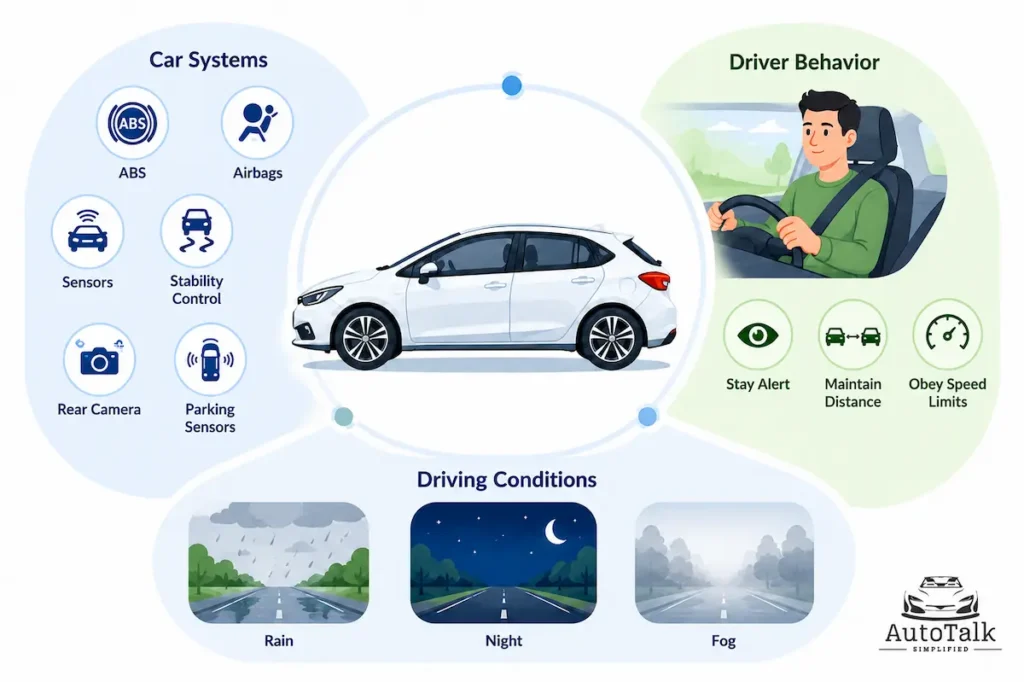
Every driver has experienced a moment when traffic suddenly slows down or a vehicle ahead brakes unexpectedly. In situations like these, maintaining a safe following distance can give you valuable extra time to react and avoid a collision.
If you’re wondering what is a safe following distance, it simply refers to the space between your vehicle and the one ahead that allows you to respond safely when road conditions change. It is one of the most important car safety basics for beginners because it helps reduce rear-end crashes and gives drivers more time to make safe decisions.
The good news is that you do not need to estimate exact feet or perform complicated calculations while driving. A few simple rules can help you judge whether you’re leaving enough space in most situations.
In this guide, you’ll learn what is safe following distance, how to measure it, how many seconds of spacing you should maintain, and how to adjust it for different driving conditions.
What Is Safe Following Distance?
A safe following distance while driving is the amount of space you leave between your vehicle and the vehicle ahead. This space gives you enough time to recognize a problem, react, and slow down or stop safely if traffic suddenly changes.
Many drivers focus only on braking distance, but reaction time is just as important. Before your vehicle begins to slow down, you first need to notice the hazard and move your foot to the brake pedal. Even a delay of a second or two can make a significant difference when traffic stops unexpectedly.
Why This Distance Matters
Maintaining a proper following distance helps reduce the risk of rear-end collisions, which are among the most common types of traffic accidents. When you leave enough space, you have more time to react to sudden braking, lane changes, road hazards, or unexpected traffic conditions.
A safe gap also places less stress on your vehicle. Good brakes and tires play an important role in stopping safely, which is one reason regular vehicle care remains an important part of preventive car maintenance.
The goal is not to stay as far away as possible from other vehicles. Instead, it is to leave enough space to react safely while keeping pace with traffic.
Now that you understand what safe following distance means and why it matters, let’s look at the simple rule many drivers use to measure it while driving.
What Is the Safe Following Distance Rule? (The 3-Second Rule Explained)
The most common following distance rule is the 3-second rule. Instead of estimating feet, meters, or car lengths, this method uses time to determine whether you are leaving enough space behind the vehicle ahead.
How the 3-Second Rule Works
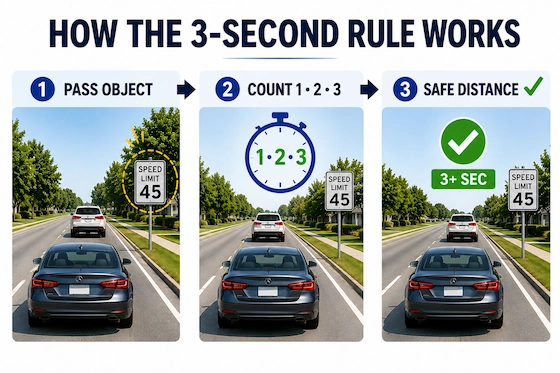
Using the 3-second rule is simple. Choose a fixed object near the road, such as a sign, pole, or overpass. When the vehicle ahead passes that object, begin counting:
“One-thousand-one, one-thousand-two, one-thousand-three.”
If your vehicle reaches the same object before you finish counting, you are following too closely and should increase the gap. If you finish counting before reaching the object, you are maintaining at least a 3-second following distance.
This quick check can be used almost anywhere and takes only a few seconds to perform while driving.
Why Time-Based Distance Works Better
Many drivers try to judge distance by counting car lengths, but that approach can be misleading. The space represented by three car lengths at 25 mph is very different from three car lengths at 65 mph.
Using time automatically adjusts for speed. As your speed increases, the physical distance covered in three seconds becomes larger. As your speed decreases, the distance becomes shorter. This makes the 3-second rule a more practical and consistent way to judge safe spacing in everyday driving.
This simple rule works well in most normal driving situations. However, the amount of space you need can change depending on your speed and driving conditions.
How Many Seconds Is a Safe Following Distance?
The amount of space you should leave behind another vehicle is not always the same. Whether you own a SUV, sedan, or hatchback, a minimum following distance of 3 seconds is generally recommended during normal driving conditions. This provides enough time to notice a hazard, react, and begin slowing down if traffic ahead changes unexpectedly.
However, the safest following distance depends on factors such as speed, visibility, weather, and traffic conditions.
Standard Driving Conditions
During everyday driving on dry roads with good visibility, a safe following distance in seconds is typically at least three seconds. This works well for most city streets and suburban roads where traffic is moving normally and road conditions are favorable.
Highway Driving
As vehicle speed increases, the distance covered each second also increases. This is why many drivers choose to leave a larger gap on faster roads. Maintaining a larger gap on highways can provide additional reaction time if traffic suddenly slows or stops ahead. In general, a greater safe following distance highway buffer is recommended as speeds increase.
Rain and Wet Roads
Road conditions can have a major impact on stopping distance. Water reduces tire grip and can make it harder for a vehicle to slow down quickly. Because of this, drivers should increase their safe following distance in rain and leave extra space between vehicles whenever roads are wet or visibility is reduced.
Other Situations That Require More Space
Night driving, heavy traffic, and large vehicles can also affect how much room you should leave. Darkness can make hazards harder to identify, while trucks and buses may block your view of traffic farther ahead. In stop-and-go traffic, additional spacing can help reduce sudden braking and give you more time to react.
There is no single distance that works perfectly in every situation. Instead, what is the recommended safe following distance depends on the conditions around you, including speed, visibility, traffic flow, and road surface. As conditions become more challenging, your following distance should increase as well.
Now that you know how following distance changes in different situations, let’s look at some simple habits that can help you maintain that space consistently while driving.
How to Maintain Safe Following Distance While Driving
Knowing the recommended following distance is one thing. Maintaining it consistently while driving is what actually helps keep you safe on the road. Traffic conditions change constantly, and other drivers do not always behave predictably. Developing a habit of monitoring and adjusting your following distance can help you react more safely to changing situations without making driving feel complicated.
Use Time Instead of Distance
Many drivers wonder how much distance to keep between cars during everyday driving. Rather than trying to estimate exact distances, use the 3-second rule as a quick reference throughout your trip.
Choose a roadside object occasionally and check whether you still have an adequate time gap behind the vehicle ahead. This simple habit takes only a few seconds and can help you identify when you’re beginning to follow too closely without realizing it.
Adjust Constantly While Driving
Following distance is not something you set once and forget. Traffic speeds, weather conditions, visibility, and road conditions can change throughout a trip.
For example, if traffic begins moving faster, you may need to increase the space ahead of you. If rain starts falling or visibility decreases, leaving a larger gap can provide additional reaction time. Likewise, if a vehicle cuts into your lane, simply ease off the accelerator and rebuild a safe gap instead of continuing to follow too closely.
The key is to treat the following distance as something that should be adjusted continuously rather than a fixed measurement.
This makes maintaining a safe distance much easier without overthinking it.
Several factors can influence how much space you actually need between vehicles, which is why understanding those factors is just as important as knowing the basic rule.
What Factors Affect Safe Following Distance?
Several factors influence how much space you need between your vehicle and the one ahead. While general rules provide a useful starting point, real-world driving conditions can change how quickly you can react and stop safely.
Speed
Speed is one of the biggest factors affecting following distance. As speed increases, your vehicle travels farther every second and requires more distance to come to a complete stop.
This is why a gap that feels comfortable in city traffic may not provide enough reaction time at highway speeds. Understanding this relationship is an important part of maintaining a safe following distance at different speeds.
Weather Conditions
Rain, fog, snow, and other weather conditions can affect both visibility and vehicle control. Drivers may have less time to identify hazards, while reduced traction can increase stopping distance.
Even light rain can make roads more slippery than many drivers expect, especially when it first begins to fall.
Road Surface
The condition of the road itself also plays a role. Wet pavement, loose gravel, potholes, uneven surfaces, or icy roads can reduce tire grip and make braking less predictable.
When road conditions are poor, vehicles may require more distance to stop safely than they would on a dry, well-maintained surface.
Driver Reaction Time
Not every driver reacts at the same speed. Fatigue, distractions, stress, and inattention can all delay the time it takes to recognize a hazard and begin braking.
Because drivers cannot always predict how quickly they will react in an emergency, maintaining at least a minimum safe following distance provides an important safety margin.
Vehicle Condition
A vehicle’s condition can also influence stopping performance. Worn tires may provide less traction, while poorly maintained brakes can increase stopping distance.
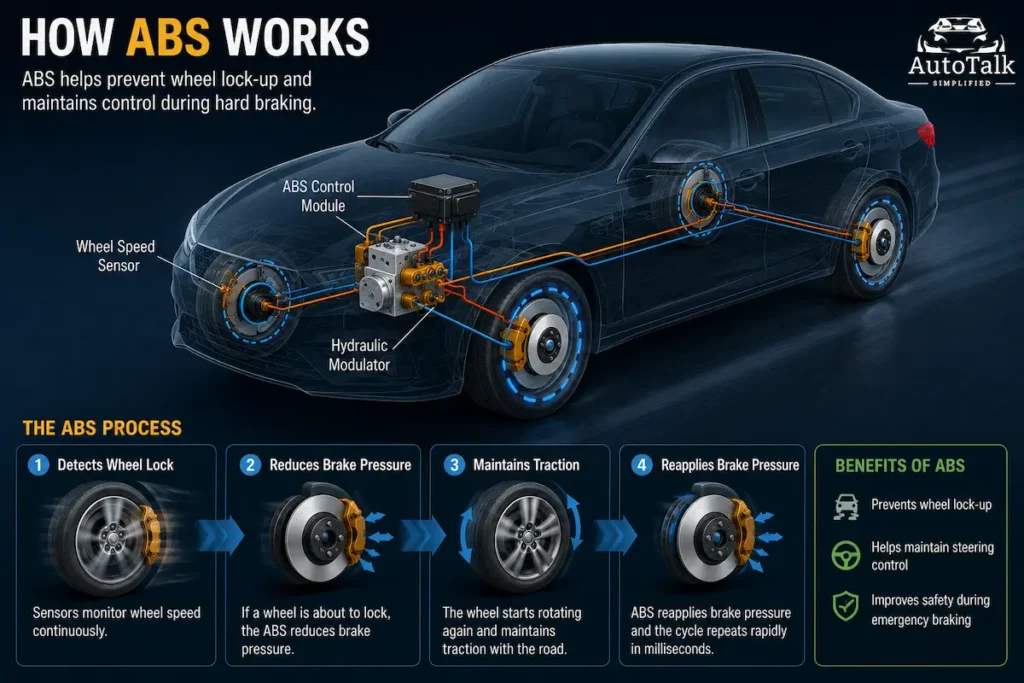
This is one reason systems such as ABS (Anti-lock Braking System) are designed to help drivers maintain control during hard braking. However, even advanced safety features cannot eliminate the need for adequate following distance.
Understanding these factors makes it easier to adjust your following distance when conditions change instead of relying on a single fixed rule in every situation.
Even with this knowledge, many drivers still make mistakes that reduce the safety benefits of maintaining a proper following distance.
Common Following Distance Mistakes Drivers Make
Knowing the rules is important, but many drivers still develop habits that reduce the effectiveness of a safe following distance. Recognizing these mistakes can help you avoid unnecessary risks and maintain more consistent spacing on the road.
Following Too Closely in Fast-Moving Traffic
One of the most common mistakes is reducing the gap as traffic speeds increase. Some drivers feel comfortable because traffic is flowing smoothly, but higher speeds leave less time to react if a vehicle ahead suddenly brakes or changes lanes.
Treating the 3-Second Rule as a Fixed Limit
The 3-second rule is a useful guideline, not a rule that applies in every situation. Weather, visibility, road conditions, and traffic patterns can all require additional space. Drivers who never adjust their following distance may leave themselves with too little reaction time when conditions change.
Focusing on Car Lengths Instead of Time
Many drivers still judge distance by counting vehicle lengths. This often leads to inconsistent spacing because the same physical gap may be safe at lower speeds but insufficient at higher speeds.
If you’ve ever wondered how many car lengths is safe, there is no single answer that works in every situation. Time-based spacing is generally more reliable because it automatically adjusts as speed changes.
Not Rebuilding a Gap After a Vehicle Merges
Another common mistake occurs when another vehicle moves into the space ahead. Many drivers continue at the same distance instead of gradually creating a safe gap again.
When this happens, simply ease off the accelerator and allow additional space to develop naturally. Aggressive braking or tailgating usually creates more risk rather than solving the problem.
Avoiding these mistakes can make following distance easier to manage and help create a larger margin for error during everyday driving.
Frequently Asked Questions
How often should I check my following distance?
You do not need to check it constantly, but it is a good habit to reassess your following distance whenever traffic speed, weather, visibility, or road conditions change. A quick check every so often can help ensure you are not gradually drifting too close to the vehicle ahead.
Should new drivers leave more following distance?
Yes. New drivers often need more time to recognize hazards and respond to changing traffic conditions. Leaving additional space can help build confidence and provide a larger margin for error while gaining driving experience.
What should I do if another vehicle cuts into my gap?
The safest response is to gradually restore your following distance. Ease off the accelerator if necessary and allow additional space to develop rather than tailgating the vehicle that merged ahead.
Can modern safety features replace safe following distance?
No. Features such as automatic emergency braking, adaptive cruise control, and collision warnings can provide additional support, but they do not eliminate the need for safe driving habits. Drivers should always maintain adequate spacing regardless of the technology in their vehicle.
Conclusion
Maintaining a safe following distance is one of the simplest ways to reduce risk and improve safety behind the wheel. By giving yourself enough time to react to changing traffic conditions, you can make better driving decisions and lower the chances of a rear-end collision.
While the 3-second rule provides a useful starting point, the safest following distance depends on factors such as speed, weather, visibility, and traffic conditions. Learning when to increase that gap is just as important as knowing the rule itself.