
Many first-time car owners know about oil changes. But only a few fully understand what they involve. Oil change basics start with knowing how engine oil works and why it plays such an important role in keeping your car running smoothly.
An oil change is the process of removing old, worn-out engine oil and replacing it with fresh one and a new filter. This service protects the engine’s moving parts, helps control heat, and reduces buildup that forms over time.
New owners often misunderstand oil service. Some believe it only matters when a warning light appears. Others delay it because the car still seems to run fine. In reality, understanding why oil changes are important can prevent long-term engine wear. It can also help avoid costly repairs.
This guide focuses on building awareness, not teaching DIY steps. You will learn what an oil change really does, how oil supports your engine, and what can happen if oil service is delayed. When you understand the basics, preventive maintenance becomes less confusing and easier to manage.
Oil Change Basics For Beginners
Understanding oil change basics starts with knowing what the service actually does. Many first-time owners think it is a routine check that keeps the dashboard light off. In reality, it is one of the most important preventive car care steps for protecting your engine over time.
What Is An Oil Change?
To understand what an oil change is, you first need to understand the role of engine oil. Your engine contains many moving metal parts that operate at high speeds. When these parts move, they create friction and heat. These moving parts work together constantly, which is easier to understand when you know how a car engine works.
Engine oil moves through the engine and forms a thin protective layer between these components. This layer reduces direct metal-to-metal contact and lowers friction. By reducing friction, the oil helps prevent unnecessary wear inside the engine.
The motor oil also helps manage heat and carry away tiny particles created during normal operation. Over time, the oil collects dirt and debris. As it becomes contaminated and breaks down, it loses its ability to protect the engine effectively.
An oil change removes the old, degraded oil and replaces it with fresh oil. The oil filter is replaced as well so it can continue trapping contaminants. This restores proper lubrication and helps the engine operate smoothly and safely.
How Engine Oil Works Inside Your Car
Inside your engine, metal components move at very high speeds. These parts are constantly exposed to heat and pressure during normal driving. Without protection, friction would quickly damage internal surfaces.
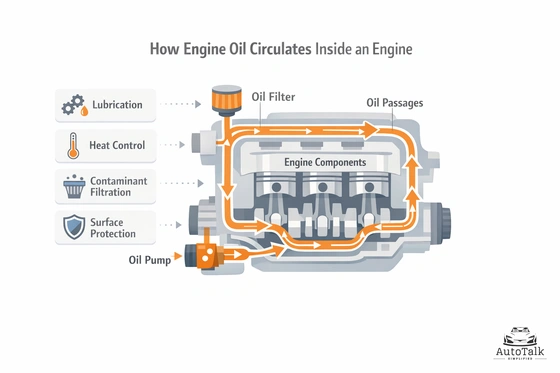
Engine oil performs several essential functions at the same time:
- Lubrication: It forms a thin protective film between moving parts. This reduces friction and limits direct metal contact.
- Heat Control: As oil moves, it absorbs heat from internal components. It helps distribute that heat more evenly.
- Contaminant Suspension: Tiny particles such as carbon deposits and microscopic metal fragments mix into the oil. The oil filter then traps many of these contaminants.
- Surface Protection: Oil helps protect internal metal surfaces from corrosion and excessive wear.
When oil is clean and stable, these functions work together smoothly. As oil ages and breaks down, its ability to protect the engine gradually weakens.
Why Clean Oil Matters More Than Most Owners Realize
Many first-time owners do not immediately see why oil changes are crucial because engine wear happens slowly. The car may continue running even when oil quality declines.
As oil degrades:
- Friction inside the engine increases.
- Heat management becomes less effective.
- Contaminants build up in the oil.
- Protective film strength weakens.
These basic oil-related changes develop gradually, not suddenly. Over time, rising friction and heat place additional stress on engine components. The engine may still operate normally at first, but internal wear continues to accumulate. Small increases in stress compounds over thousands of miles.
Clean oil supports smoother movement, balanced temperatures, and steady long-term performance. Understanding this gradual process encourages preventive maintenance rather than waiting for warning signs.
Why Oil Changes Are Important For First-Time Owners
Many new drivers focus on visible maintenance like tires or fuel. Engine oil works quietly inside the engine, yet it plays a central role in durability, efficiency, and long-term repair costs. Understanding why oil changes are important helps you see maintenance as protection rather than just routine service.
Engine oil operates under constant heat and pressure. Over time, oil degradation reduces its ability to control friction, stabilize temperature, and manage contamination. The longer aging oil remains in circulation, the weaker its protective properties become.
The importance of regular oil service is not about reacting to breakdowns. It is about limiting cumulative engine stress and preserving internal stability over thousands of miles.
Engine Protection and Long-Term Reliability
Every time your vehicle runs, internal components move at extremely high speeds. These components depend on a stable lubrication layer to prevent direct metal contact. When lubrication remains consistent, mechanical movement stays controlled and efficient.
Clean oil supports:
- Strong lubrication film strength
- Balanced internal temperature regulation
- Reduced microscopic surface wear
- Improved oil circulation efficiency
- Protection against corrosion buildup
As oil ages, its viscosity and chemical balance shift. This change weakens the lubrication barrier that separates moving parts. Although the engine may still feel smooth, internal resistance slowly increases.
Over time, rising friction and heat contribute to long-term engine wear. Recognizing this slow process helps you understand how consistent maintenance supports engine reliability. You finally learn that preventing warning lights is not the solution.
What Happens If You Delay an Oil Change
Doing a regular oil change is an integral part of owning a car. Delaying it can cause problems. In most cases, the impact is progressive rather than immediate. The engine continues operating, but protective efficiency declines.
When oil replacement is postponed:
- Oil contamination buildup increases
- Circulation through narrow engine passages slows
- Friction levels steadily rise
- Heat distribution becomes less stable
- Lubrication film strength weakens
Extended delays may allow sludge to develop. Sludge is a thick residue formed when degraded oil mixes with contaminants. This buildup can restrict proper oil flow inside the engine lubrication system.
Restricted flow reduces protection in critical areas such as bearings and piston assemblies. The result is gradual internal strain that compounds with continued driving.
How Delays Turn Small Neglect Into Bigger Repairs
Engine components are interconnected. When lubrication performance declines, stress does not remain isolated to one part. Increased internal resistance can influence surrounding systems.
Over extended periods, poor oil condition may affect the following:
- Bearing surface durability
- Piston ring sealing efficiency
- Valve train smoothness
- Fuel efficiency and emissions balance
Repeated exposure to elevated friction and heat accelerates mechanical fatigue. The minor maintenance postponements can increase the chances of more complex repairs later.
Preventive engine care remains one of the most cost-effective ownership habits and a key part of overall car maintenance basics. Consistent oil maintenance supports mechanical stability. It reduces long-term repair risk and strengthens overall engine longevity.
Different Types of Engine Oil
Not all engine oil is the same. Every type is designed to lubricate and protect internal components. But they differ in formulation. This difference affects durability, heat resistance, and how long the oil maintains stability under pressure.
Understanding basic oil categories helps you make informed decisions without needing deep mechanical knowledge.
Conventional Vs Synthetic Oil
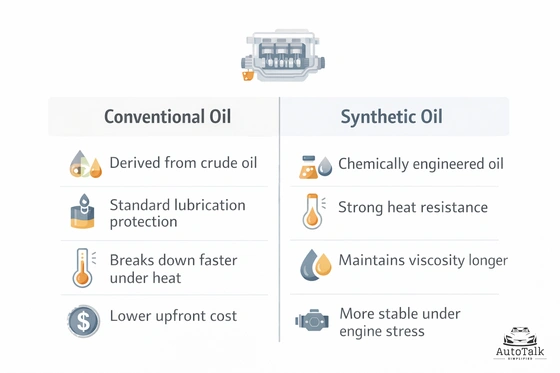
The two most common categories are conventional engine oil and synthetic engine oil. Both perform the same core functions. But they differ in refinement and performance stability.
Conventional Oil
- Derived directly from refined crude oil
- Provides standard engine lubrication protection
- Breaks down faster under extreme heat
- Typically lower upfront cost
Conventional oil works well for normal driving conditions. However, it tends to degrade more quickly under high temperatures or heavy engine stress.
Synthetic Oil
- Chemically engineered for improved stability
- Maintains consistent viscosity under heat
- Resists oil breakdown under high temperatures
- Often supports longer-lasting performance
Synthetic oil is designed to handle wider temperature ranges and higher stress levels. It resists thermal breakdown more effectively. And often maintains protective qualities longer than conventional oil.
From a cost perspective, synthetic oil usually costs more per service. But the improved durability may balance that difference over time. Yet, it largely depends on your driving habits and manufacturer recommendations.
Does Oil Type Change How Often You Need Service?
Oil type can influence how long the oil maintains its protective properties. But it does not replace manufacturer guidance. Synthetic formulations generally resist engine oil degradation longer than conventional oil.
However, several factors affect service frequency:
- Driving conditions
- Climate extremes
- Stop-and-go traffic
- Towing or heavy loads
- Manufacturer-recommended oil service interval
Even high-performance oil eventually accumulates contaminants and loses effectiveness. Synthetic oil may provide longer-lasting stability and regular monitoring. But following your vehicle’s maintenance schedule for new owners remains essential.
Choosing the correct oil type supports the overall longevity of your engine. But consistent maintenance habits matter more than the label on the bottle.
Common Oil Change Myths First-Time Owners Believe
Many beginners hear conflicting advice about oil change basics. Some advice comes from outdated practices. Some come from misunderstandings about modern engines. Clearing up these myths helps you make decisions based on facts rather than assumptions.
New Cars Don’t Need Early Oil Changes
Some owners believe that newer vehicles do not need early oil service. The reason is because engines are more advanced. Modern engines are surely more efficient. But they still rely on proper lubrication from the start.
During the first months of driving, internal components settle into normal operating patterns. Small metal particles may be produced as parts break in. Regular oil service supports proper contaminant removal and stable lubrication during this period.
Even new engines depend on consistent oil circulation and filtration. Technology reduces risk, but it does not eliminate the need for maintenance.
I Can Wait Until The Warning Light Comes On
Some drivers assume they only need service when a dashboard indicator appears. This approach treats maintenance as reactive rather than preventive.
Many vehicles use an oil life monitoring system that estimates oil condition based on driving behavior. This system does not directly measure oil quality. It calculates remaining service life using data such as engine temperature and operating patterns.
There is also a difference between an oil pressure warning light and an oil life reminder. The oil pressure light signals a serious lubrication issue. Waiting for that warning can state that protective oil circulation has already been compromised.
Relying only on warning lights can delay maintenance longer than recommended. Preventive care reduces uncertainty and supports long-term engine reliability.
Oil Looks Clean, So It Must Be Fine
Engine oil can appear clean on the dipstick while still losing protective strength. Color alone does not determine oil quality.
As oil circulates, it absorbs heat and collects microscopic contaminants. Many of these particles are too small to see easily. Chemical breakdown also occurs over time, even if the oil still looks clear.
Visual inspection provides limited information. Proper service timing is based on usage patterns and manufacturer guidance. So relying entirely on appearance is not the right move.
Oil Changes Are Just A Way For Shops To Make Money
Some people view routine oil service as unnecessary upselling. In reality, engine lubrication directly affects long-term mechanical durability.
Regular oil replacement removes contaminants, restores protective film strength, and supports consistent circulation. Skipping service may reduce short-term spending, but it increases long-term mechanical risk.
Preventive maintenance is not about selling extra services. It is about preserving internal engine components that are costly to repair or replace.
Signs Your Oil May Need Attention
Understanding oil change basics for beginners also means recognizing early signals of declining oil conditions. Engine oil rarely fails all at once. Instead, small changes develop gradually as lubrication performance weakens.
Paying attention to these early signs supports preventive care and reduces long-term engine stress.
Subtle Performance Changes
When oil begins losing protective strength, engine behavior may change slightly. These changes are often mild at first and easy to ignore.
You might notice:
- Slight increase in engine noise
- Reduced smoothness while idling
- Minor hesitation during acceleration
- Less refined overall engine feel
As oil degrades, friction inside the engine slowly increases. Higher friction affects how smoothly internal parts move. These changes usually build gradually rather than appearing suddenly.
Visible or Measurable Clues
In some cases, oil conditions may show more noticeable indicators.
Possible signs include:
- Darkened or thickened oil on the dipstick
- A burnt oil smell
- Engine running hotter than usual
- Reduced fuel efficiency
Oil naturally darkens over time, so color alone does not confirm failure. Thick texture, unusual odor, and performance changes can also suggest declining lubrication quality.
Recognizing these signs supports timely maintenance. They also reinforce the practical understanding behind oil service decisions.
Frequently Asked Questions
How Often Should First-Time Owners Change Engine Oil?
Service frequency depends on your vehicle, driving habits, and oil type. Most manufacturers provide a recommended service interval in the owner’s manual. But if you drive in heavy traffic or extreme temperatures or take frequent short trips, you may need more frequent oil replacement. Oil change basics are more about following manufacturer guidance and avoiding guesswork.
Is Synthetic Oil Better For Beginners?
Synthetic oil is engineered to provide stronger stability under heat and pressure. It often resists breakdown longer than conventional oil. However, “better” depends on your vehicle’s design and manufacturer recommendation. The most important factor is using the oil type specified for your engine.
Can Skipping One Oil Change Ruin An Engine?
In most cases, skipping one service does not cause immediate engine failure. Engine wear typically develops gradually. However, repeated delays increase internal friction and contamination buildup. Over time, this can shorten engine lifespan and increase repair risk.
Does Oil Type Affect Engine Lifespan?
Oil type can influence how well lubrication performs under stress. Higher-quality oil may maintain protective properties longer. Still, consistent maintenance matters more than the label. Regular replacement has a greater impact on longevity than brand choice alone.
Is An Oil Filter Always Replaced During An Oil Change?
Yes. The oil filter is normally replaced during every oil service. The filter traps dirt and contaminants suspended in the oil. Replacing the filter ensures that fresh oil circulates. It eliminates the chances of carrying over deposited debris from the previous service.
Conclusion
Understanding oil change basics for beginners helps you make confident maintenance decisions. Engine oil protects internal components from gradual wear and heat stress.
Consistent oil service supports long-term reliability and reduces avoidable repair risk. Simple, regular maintenance matters more than waiting for warning signs.
Small preventive habits today protect your engine over time.
💬 Not sure when your car actually needs an oil change?
Ask in the comments, and I’ll help you understand what generally affects oil change timing and what to pay attention to.