Have you ever been driving on a highway and suddenly realized your vehicle was closer to another lane than you intended? It can happen faster than many drivers expect. A momentary distraction, fatigue, or even a quick glance away from the road can sometimes cause a vehicle to drift without the driver immediately noticing.
To help reduce this risk, many modern vehicles now include a lane departure warning system. Rather than taking control of the vehicle, the feature is designed to make drivers aware of situations where they may be unintentionally moving out of their lane.
As vehicles continue to adopt more advanced safety technologies, understanding how these features work has become an important part of learning about modern vehicle safety. Each system is designed to address a different driving risk, and lane departure warning focuses specifically on helping drivers stay aware of their lane position.
In this guide, you’ll learn what is lane departure warning, how it works, when it activates, and how it differs from similar features found in many modern vehicles.
What Is a Lane Departure Warning System?
A lane departure warning system is a driver-assistance feature that monitors your vehicle’s position within its lane and alerts you when it detects unintentional lane drift. The warning is designed to draw your attention to the situation so you can make the necessary correction.
The system works in the background while you drive and is designed to support driver awareness rather than replace it. When the vehicle begins moving out of its lane under certain conditions, the system provides a warning so the driver can respond appropriately.
Understanding this basic role makes it easier to see what the system is monitoring and how it operates while you’re driving.
How the Lane Departure Warning System Works While Driving
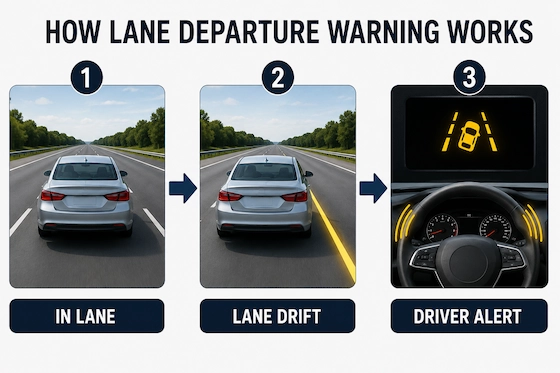
A common question drivers have is how does lane departure warning work while the vehicle is moving. Although the process happens automatically in the background, the system continuously monitors the vehicle’s position relative to the lane markings on the road.
How the System Detects Lane Markings
Most vehicles use a lane departure warning system camera mounted near the windshield to observe the road ahead. In some vehicles, additional components may assist the system, but the camera is typically responsible for identifying lane markings and tracking their position.
The system continuously scans the road and looks for visible lane lines so it can determine where the vehicle is traveling within the lane.
How the System Detects Lane Drift
Once the lane markings have been identified, the system tracks the vehicle’s position between them. As the vehicle moves, it continuously checks whether the car is remaining within its lane or gradually moving toward a lane boundary.
If the vehicle begins drifting toward another lane without an obvious indication that the driver intends to change lanes, the system recognizes the movement as potential lane departure.
How the Driver Gets Alerted
After detecting possible lane drift, the system warns the driver using one or more alerts. Depending on the vehicle, this may include a lane departure warning symbol or light, on the instrument cluster, an audible chime, or a vibration through the steering wheel.
The goal of these alerts is not to startle the driver but to quickly draw attention to the vehicle’s position so corrective action can be taken.
Now that you understand how the system detects lane position and provides warnings, let’s look at the conditions that determine when lane departure warning light activates while driving.
When Does Lane Departure Warning Activate?
Many drivers assume the system is monitoring lane position every time the vehicle is moving. While it may be active in the background, warnings are usually provided only when certain conditions are met.
Visible Lane Markings Are Required
For the system to recognize lane position, it must be able to see the lane markings on the road. If the lane lines are clearly visible, the system can determine whether the vehicle is staying within its lane or moving toward a lane boundary.
The Vehicle Must Usually Be Above a Certain Speed
In most vehicles, lane departure warning is designed primarily for higher-speed driving. Because of this, the feature often activates only after the vehicle reaches a minimum speed set by the manufacturer.
The exact speed varies between vehicles, which is why some drivers may notice the system working on highways but not during slower city driving.
Turn Signals Affect System Behavior
The system is designed to identify unintentional lane drift, not normal lane changes. When a turn signal is used before changing lanes, the vehicle recognizes that the movement is intentional and typically does not issue a warning.
This helps prevent unnecessary alerts during routine driving maneuvers.
When It May Not Work
Like many driver-assistance technologies, the system depends on being able to accurately identify lane markings. In some situations, this may not be possible.
Common examples include:
- Heavy rain or dense fog
- Faded or missing lane markings
- Roads with unclear lane boundaries
- Sharp curves that make lane detection more difficult
Understanding these conditions helps explain why the system may not always provide warnings, even when it appears to be turned on.
Now that you know when does lane departure warning activate, let’s look at how it differs from another commonly misunderstood safety feature: Lane Keeping Assist.
Lane Departure Warning vs Lane Keeping Assist (Simple Difference)
Many car owners assume Lane Departure Warning and Lane Keeping Assist are the same feature, but they serve different purposes.
A lane departure warning system is designed to notify the driver when the vehicle begins drifting out of its lane unintentionally. Its role is to provide a warning so the driver can take corrective action.
Lane Keeping Assist goes a step further. Instead of only warning the driver, the system can provide steering assistance to help guide the vehicle back toward the center of the lane when certain conditions are met.
The Simplest Way to Remember the Difference
- Lane Departure Warning = Warns the driver
- Lane Keeping Assist = Warns and may provide steering assistance
Imagine your vehicle begins drifting toward another lane without a turn signal. A lane departure warning system may alert you to the movement, while Lane Keeping Assist may also provide steering assistance to help guide the vehicle back toward the lane.
Why Many Drivers Get Confused
Many modern vehicles include lane keep assist with lane departure warning as part of the same safety package. Because both systems often work together, drivers may not immediately realize that one feature provides alerts while the other can provide steering assistance.
Understanding this difference helps set realistic expectations about what your vehicle can and cannot do while driving.
Now that the distinction is clear, let’s look at why lane departure warning remains an important safety feature even though it does not actively steer the vehicle.
Why Lane Departure Warning Matters for Safety
A lane departure warning system is designed to improve driver awareness in situations where a vehicle begins moving away from its intended lane. While the feature does not control the vehicle, it can provide an early warning that helps drivers recognize a potential problem before it develops into a more serious situation.
One of the biggest safety benefits of the system is that it helps draw attention back to the driving task. A warning received at the right moment may give the driver additional time to recognize what is happening and respond appropriately.
The feature can be particularly valuable during longer drives, where fatigue or reduced concentration may make it easier to overlook small changes in vehicle position. Even a brief alert can help drivers become aware of a situation they may not have noticed immediately.
Lane departure warning is most effective when used alongside other safe driving habits. Features that help drivers stay aware of their surroundings work best when combined with practices such as maintaining a safe following distance and regularly monitoring traffic conditions.
While the safety benefits are valuable, it is equally important to understand that the system has limitations and cannot prevent every situation on its own.
Limitations and Common Issues You Should Know
Like any modern vehicle safety feature, a lane departure warning system has limitations. While it can help improve awareness, it is not designed to replace driver attention or work perfectly in every driving situation.
System Limitations
The system relies on being able to identify lane markings on the road. If lane lines are unclear, missing, or difficult to detect, its ability to provide accurate warnings may be reduced.
It is also important to remember that the feature cannot make driving decisions for you. While it can alert you when the vehicle begins drifting from its lane, it does not replace checking the road, monitoring traffic, or staying focused behind the wheel.
Because of these limitations, lane departure warning should be viewed as a helpful safety aid rather than a substitute for attentive driving.
Common Warning or Malfunction Situations
In some vehicles, a lane departure warning light may appear when the system detects a fault or is temporarily unavailable. This can happen for several reasons.
A blocked lane departure warning sensor or camera is one of the most common causes. Dirt, mud, snow, heavy rain, or other obstructions can sometimes interfere with the system’s ability to monitor lane markings accurately.
Drivers may also see warnings when lane markings are difficult to detect or when the vehicle is traveling in conditions that make lane recognition unreliable.
If a warning appears, the vehicle’s owner’s manual can help explain the specific meaning and recommended action. Understanding what these warnings indicate can help drivers avoid confusion and use the feature more effectively.
For drivers who prefer different alert settings, many vehicles also allow certain lane departure warning features to be adjusted.
Can You Turn Off or Adjust Lane Departure Warning?
In many vehicles, lane departure warning settings can be adjusted through the vehicle’s settings menu. Depending on the model, drivers may be able to change alert sensitivity or customize how warnings are delivered.
If you’re wondering how to turn off lane departure warning, many vehicles allow the feature to be temporarily disabled. However, doing so means you will no longer receive alerts when the vehicle begins drifting from its lane.
The exact options vary by vehicle, so it’s always best to consult the owner’s manual for model-specific information.
How Lane Departure Warning Fits Into Overall Car Safety
If you’re wondering what does lane departure warning do within a vehicle’s overall safety system, its primary role is to help drivers stay aware of their lane position and recognize unintended lane drift.
However, modern vehicles often use multiple safety features that focus on different types of risks. For example, blind spot monitoring helps drivers detect vehicles that may be difficult to see in adjacent lanes, while automatic emergency braking is designed to help reduce the severity of certain forward collisions.
Each system addresses a different driving challenge, but together they help improve overall driver awareness and safety.
Frequently Asked Questions
Why does my lane departure warning light turn on?
A lane departure dashboard light may appear when the system is actively providing an alert or when it detects a condition that affects normal operation. The exact meaning can vary by vehicle, so it is best to consult the owner’s manual for model-specific information.
Does lane departure warning work at all speeds?
Not usually. Most systems are designed to operate above a minimum speed set by the manufacturer. Because of this, drivers may notice the feature working on highways but not during slower city driving.
Can lane departure warning prevent accidents?
The system can help reduce risk by providing early warnings when a vehicle begins drifting from its lane. However, it cannot prevent every accident and should not be viewed as a replacement for attentive driving.
Can an aftermarket lane departure warning system be added to a car?
Yes. Some aftermarket systems are available for vehicles that did not come with the feature from the factory. These systems typically use external cameras or sensors, although performance and accuracy may vary compared to factory-installed systems.
Conclusion
A lane departure warning system is designed to help drivers stay aware of their vehicle’s position on the road by providing alerts when unintentional lane drift is detected. While the feature does not control the vehicle, it can serve as an additional layer of awareness during everyday driving.
Understanding how the system works, when it activates, and what its limitations are can help you use it more effectively. Like other modern vehicle safety features, it works best when combined with attentive driving habits and responsible decision-making behind the wheel.