Traffic conditions can change in an instant, which is why features like forward collision warning have become increasingly common in modern vehicles. A vehicle ahead may brake suddenly, traffic may slow down unexpectedly, or a driver may become distracted for a brief moment. In situations like these, even a small delay in reacting can increase the risk of a collision.
To help drivers recognize potential hazards sooner, many vehicles now include technologies designed to monitor the road ahead and provide timely warnings. These systems are intended to support driver awareness and encourage quicker responses when traffic conditions change unexpectedly.
Understanding how these features work is an important part of learning about driving safety systems and the role they play in newer cars. While they can provide valuable assistance, it is equally important to understand what they can and cannot do.
In this guide, you’ll learn what is forward collision warning, how it works, when it activates, and how it compares to other safety technologies found in many vehicles today.
What Is a Forward Collision Warning System?
A forward collision warning system is a safety feature that monitors the road ahead and alerts drivers when it detects a potential collision risk. The purpose of the warning is to give the driver additional time to recognize a hazard and respond appropriately.
Unlike some other safety technologies, the system is designed to provide alerts rather than take action on its own. When it identifies a situation that may lead to a collision, it notifies the driver so they can decide how to respond.
This feature is intended to support driver awareness during everyday driving and can be especially helpful when traffic conditions change unexpectedly.
What Does a Forward Collision Warning System Do?
A common question drivers have is what does forward collision warning do during everyday driving. Its primary job is to monitor traffic conditions ahead and alert the driver when it detects a situation that may increase the risk of a front-end collision.
As you drive, the system continuously watches the distance between your vehicle and objects ahead. If traffic slows unexpectedly or your vehicle begins closing the gap too quickly, the system may issue a warning to help draw your attention to the situation.
The purpose of these warnings is to provide additional reaction time. An earlier warning can help drivers recognize a developing hazard and decide how to respond.
Types of Alerts You May See
Different vehicles use different types of warnings. Some may display a visual alert on the instrument cluster or windshield, while others may use an audible forward collision warning alert sound to get the driver’s attention.
Certain vehicles may also use steering wheel or seat vibrations as an additional warning method. Regardless of the type of alert, the goal remains the same: to make drivers aware of a potential collision risk as early as possible.
Now that you know what the system does, let’s look at how it actually detects vehicles and identifies potential hazards on the road.
How Forward Collision Warning Works While Driving
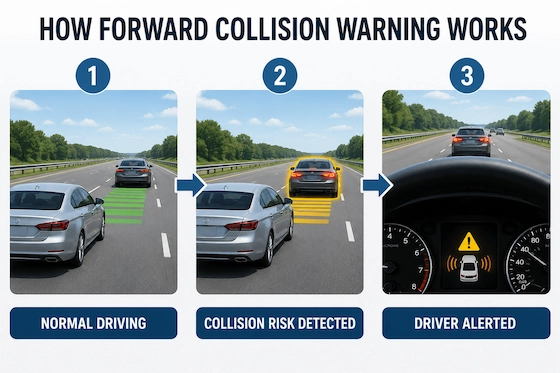
A forward collision warning system works by continuously monitoring the road ahead and evaluating whether a potential collision risk is developing. While the process happens automatically in the background, the system is constantly gathering information and analyzing traffic conditions in front of the vehicle.
How the System Detects Vehicles
Most vehicles use a forward collision warning system camera or similar detection technology to monitor the road ahead. These components help the system identify vehicles and other objects that may affect driving conditions.
By continuously tracking what is happening in front of the vehicle, the system can maintain awareness of changing traffic situations as you drive.
How It Calculates Collision Risk
Detecting a vehicle ahead is only the first step. The system must also determine whether the situation requires attention.
To do this, it evaluates factors such as the distance to the vehicle ahead and how quickly that distance is changing. If your vehicle is closing the gap too quickly, the system may recognize that the risk of a collision is increasing.
This evaluation happens continuously while the vehicle is moving, allowing the system to respond as traffic conditions change.
How It Warns You in Real Time
When the system determines that collision risk has increased, it can provide a warning before a crash occurs. The timing of the alert depends on factors such as vehicle speed, distance, and the level of risk detected by the system.
Because traffic situations can change quickly, these warnings are designed to give drivers additional time to recognize a potential hazard and take appropriate action.
Now that you understand how the system monitors traffic and evaluates collision risk, let’s look at the situations where it may provide warnings while driving.
When Does a Forward Collision Warning System Activate?
The exact conditions vary between vehicles, but a forward collision warning system typically activates when it detects that your vehicle is approaching another vehicle or object ahead too quickly. The goal is to alert the driver before the situation develops into a possible collision.
One common situation is approaching a slower-moving vehicle. If the gap between the vehicles begins closing faster than expected, the system may determine that a warning is needed.
The feature may also activate when traffic suddenly slows or stops ahead. In these situations, the system can provide an alert to help drivers recognize the change in traffic conditions sooner.
Another scenario involves following another vehicle too closely. If the available space ahead becomes limited and collision risk increases, the system may issue a warning to encourage a quicker response.
Common Driving Situations
Drivers may encounter forward collision warnings in a variety of everyday situations, including:
- Highway driving
- City traffic
- Stop-and-go traffic conditions
Because traffic patterns can change quickly in these environments, the system continuously monitors conditions and evaluates whether a warning may be necessary.
Now that you understand when the system may provide warnings, let’s look at how it compares with another commonly misunderstood safety feature: AEB.
Forward Collision Warning vs Automatic Emergency Braking
Many drivers assume forward collision warning and AEB are the same feature because they often work together. However, they serve different purposes.
A forward collision warning system is designed to alert the driver when it detects a potential collision risk. The warning may appear as a visual alert, an audible signal, or another notification intended to draw attention to the situation.
Automatic emergency braking, on the other hand, can take action if the driver does not respond to a developing hazard. Depending on the vehicle and circumstances, the system may automatically apply the brakes to help reduce the severity of a collision or avoid it altogether.
A Simple Example
Imagine a vehicle ahead suddenly slows down.
A forward collision warning system may warn the driver that a collision risk is increasing. If the driver does not react quickly enough, automatic emergency braking may intervene and apply the brakes automatically.
This distinction is important because some drivers expect a warning system to stop the vehicle for them. In reality, the two technologies perform different roles, even though they often work together as part of a vehicle’s overall safety package.
Some vehicles also combine these features with technologies such as adaptive cruise control, which can automatically adjust vehicle speed to help maintain a set distance from traffic ahead.
Now that the difference is clear, let’s look at why forward collision warning can play an important role in everyday driving safety.
Why Forward Collision Warning Matters for Safety
Imagine you’re driving on a highway when traffic ahead suddenly slows down. If you notice the change immediately, you have more time to react. However, if your attention is briefly elsewhere, even a small delay can make a difference.
This is where a forward collision warning system can help. By alerting drivers to a developing hazard, the system can provide valuable extra time to recognize the situation and respond appropriately.
One of the biggest benefits of the feature is improved awareness. Traffic conditions can change quickly, and drivers do not always recognize hazards immediately. A timely warning can help draw attention back to the road when it matters most.
Like blind spot monitoring, forward collision warning is designed to support driver awareness rather than replace driver responsibility. It works best when combined with safe driving habits, including maintaining a safe following distance and staying attentive behind the wheel.
While these benefits can be valuable, it is still important to understand that the system has limitations and cannot identify every possible hazard.
Common Limitations of Forward Collision Warning
A forward collision warning system can be a valuable safety feature, but it is not designed to detect every hazard or prevent every collision. Understanding its limitations can help drivers use the technology more effectively and avoid unrealistic expectations.
What the System Cannot Do
One of the most important things to remember is that the system does not replace driver attention. Even some of the most advanced driving technologies available today still require drivers to remain alert and ready to intervene when necessary. Forward collision warning is designed to assist the driver, not take control of the vehicle.
It is also important to understand that the feature does not automatically stop the vehicle. Its primary purpose is to alert the driver when collision risk increases. If the driver does not respond, a collision may still occur.
In situations where a crash cannot be avoided, other safety features such as airbags are designed to help protect vehicle occupants during the impact.
When It May Not Work Well
Like many modern vehicle safety features, forward collision warning relies on being able to accurately monitor the road ahead. Certain conditions can affect how well the system performs.
Examples include:
- Heavy rain or snow
- Dense fog
- Poor visibility
- Sharp curves in the road
- Obstructions that interfere with the system’s view
These situations do not necessarily mean the feature will stop working, but they may reduce its ability to identify potential hazards as effectively as it would under ideal conditions.
You may also notice situations where the system becomes temporarily unavailable or provides a warning related to one of its components.
Can You Turn Off or Adjust Forward Collision Warning?
In many vehicles, forward collision warning settings can be adjusted through the vehicle’s settings menu. Depending on the manufacturer and model, drivers may be able to change warning sensitivity or customize how alerts are delivered.
Some vehicles also allow the feature to be temporarily disabled. However, doing so means you may no longer receive warnings when the system detects a potential collision risk.
For example, many modern vehicles, including models such as the Toyota Camry, allow drivers to customize certain safety-related settings through the vehicle’s menu system.
Frequently Asked Questions
What Does the Forward Collision Warning Light Mean?
A forward collision warning light typically indicates that the system has detected a potential collision risk or is providing a warning to the driver. In some vehicles, the light may also appear if the system is temporarily unavailable or requires attention. Because warning symbols vary by manufacturer, it is best to consult the owner’s manual for the exact meaning in your vehicle.
Why Is My System Not Working?
There are several reasons why a forward collision warning system may not operate as expected. In some cases, a blocked forward collision warning sensor or camera can affect system performance. Dirt, snow, heavy rain, or other obstructions may temporarily interfere with the system’s ability to monitor the road ahead.
If a warning message persists, consult the owner’s manual or have the vehicle inspected according to the manufacturer’s recommendations.
Can It Detect Pedestrians?
Some forward collision warning systems are capable of detecting pedestrians, cyclists, or other road users. However, capabilities vary between vehicles and manufacturers. The system’s effectiveness may also depend on factors such as visibility, lighting conditions, and the design of the specific system.
Can an Aftermarket Forward Collision Warning System Be Added to a Car?
Yes. An aftermarket forward collision warning system can be installed in some vehicles that did not come equipped with the feature from the factory. These systems typically use external cameras or sensors to monitor the road ahead.
While some aftermarket solutions can provide useful warnings, their performance and integration may differ from factory-installed systems designed specifically for a vehicle.
Conclusion
Every driver encounters situations where traffic changes faster than expected. A vehicle ahead may brake suddenly, traffic may come to a stop, or a momentary distraction may delay your response. In these situations, even a few extra seconds can make a difference.
A forward collision warning system is designed to provide that extra awareness by alerting drivers to potential hazards before a collision occurs. While it cannot prevent every accident or replace driver attention, it can serve as an additional layer of safety that helps drivers recognize risks sooner and react more confidently on the road.