
Preventive maintenance plans for cars are structured ways to organize and track your vehicle’s care. They help you notice small issues before they turn into bigger problems.
However, many car owners never create a clear plan, which makes it harder to understand their car’s condition over time. Because of this, maintenance can start to feel confusing or uncertain.
For first-time car owners, this confusion often comes from not knowing where to start or whether planning requires technical knowledge.
In reality, a maintenance plan is not a complicated mechanical checklist. It is simply a structured way to stay organized and aware of your car’s condition over time. When vehicle care follows a clear structure, it becomes easier to understand what has already been done and what may need attention next.
This approach connects closely with preventive car maintenance, where the goal is to address potential concerns early instead of reacting only after problems appear.
Let’s break this down in a simple way so you can clearly understand how preventive maintenance planning works over time.
Key Takeaways About Preventive Maintenance Plans
Preventive maintenance plans for cars help drivers organize and track vehicle care over time. Instead of reacting only when problems appear, these plans help owners understand service history, monitor gradual wear, and make more informed maintenance decisions.
Key benefits of preventive maintenance planning include:
• keeping maintenance records organized
• understanding the vehicle’s current condition
• recognizing gradual changes as mileage increases
• making maintenance decisions with greater confidence
A simple maintenance plan does not require technical expertise. It only requires consistent recordkeeping and awareness of how the vehicle changes over time.
What Are Preventive Maintenance Plans for Cars?
A preventive maintenance plan is an organized system for tracking how a vehicle is maintained throughout its life. Instead of responding only when something breaks, this approach helps drivers stay aware of vehicle condition and maintenance history.
In simple terms, a preventive plan provides structure around car care. It helps you:
- track past services and repairs
- understand the current condition of major components
- observe gradual changes as the vehicle ages
- maintain consistent maintenance awareness
When maintenance records are clear and easy to review, drivers can better understand how the vehicle has been maintained and what attention it may need in the future.
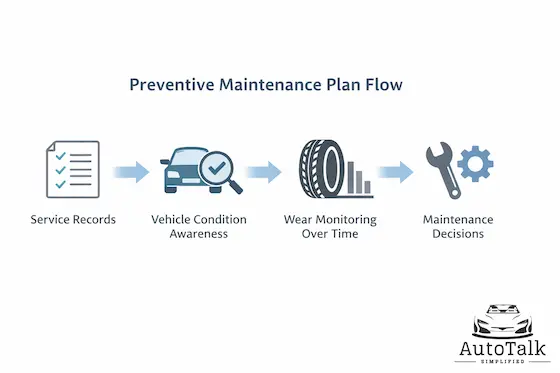
The diagram below shows how a preventive maintenance plan works as a complete system.
Why Do Preventive Maintenance Plans Matter
Preventive planning matters because it brings clarity to vehicle ownership. Without organization, drivers often rely on memory or react to sudden issues.
When maintenance information is structured and accessible:
- maintenance decisions become easier
- vehicle condition becomes clearer
- service history becomes easier to understand
Over time, this awareness supports long-term vehicle stability. Drivers can recognize patterns in how the vehicle behaves as mileage increases, such as changes in fuel efficiency or unusual noises, which can indicate the need for maintenance or repairs. This encourages a more thoughtful and consistent approach to vehicle care.
Why Most Car Owners Do Not Have a Clear Maintenance Plan
Many drivers do not create a maintenance plan because vehicle care often becomes reactive rather than organized. Maintenance decisions are frequently made only after a problem appears.
For first-time car owners especially, vehicle maintenance can feel uncertain. Without a clear system for tracking services or observing gradual changes, maintenance becomes a series of isolated actions rather than a consistent approach.
Over time, this lack of structure can make it difficult to answer simple questions such as the following:
- When was the last major service completed?
- What components have recently been replaced?
- Are there patterns in how the vehicle is wearing over time?
Without organized information, understanding the vehicle’s maintenance history becomes increasingly difficult.
Maintenance Often Feels Reactive
Many drivers begin paying attention to maintenance only after something unusual occurs. A warning light, unfamiliar noise, or change in driving performance often becomes the moment when maintenance decisions begin.
Because of this reactive pattern:
- smaller services may be delayed.
- inspections may be forgotten.
- maintenance history becomes harder to track
This situation often reflects a preventive planning mindset challenge. Instead of viewing maintenance as an ongoing process, drivers may see it as something that happens only when problems require attention.
Over time, this approach makes it harder to recognize small changes early or understand the vehicle’s long-term maintenance history.
Difference Between a Maintenance Schedule and a Strategy
Another common source of confusion is the difference between a maintenance schedule and a broader maintenance strategy.
A maintenance schedule focuses on services that should occur at specific mileage or time intervals. While these schedules are important, they do not always explain how the vehicle’s condition evolves between services.
A broader planning approach considers both scheduled services and overall vehicle condition. This awareness reflects what is sometimes called a structured maintenance approach, where maintenance decisions are supported by organization and clearer understanding of the vehicle’s history.
When drivers begin viewing maintenance as an ongoing process rather than a series of isolated tasks, planning becomes easier and vehicle care becomes more consistent.
What Preventive Maintenance Plans for Cars Actually Include
A preventive maintenance plan usually includes several ways to organize and understand how a vehicle is maintained over time. Instead of focusing only on individual repair tasks, the plan helps drivers observe patterns in vehicle condition.
Preventive planning typically involves:
- maintaining organized service records
- establishing a baseline understanding of vehicle condition
- observing gradual changes as mileage increases
- prioritizing maintenance attention when needed
Together, these elements help create a structured understanding of how the vehicle evolves throughout its life.
In practice, many drivers maintain these records using simple tools rather than complex systems. Some keep a folder with service receipts. Others track maintenance history using a spreadsheet or a notes app.
The goal of recordkeeping is not to create extra work but to make it easier to review what has already been done. When maintenance information is stored in one place, drivers can better understand service patterns and identify when the vehicle may need attention.
Service Record Organization
Service record organization means maintaining a clear and accessible history of the maintenance performed on a vehicle.
Organized records help drivers:
- remember completed services
- avoid repeating unnecessary work
- communicate clearly with service professionals
When technicians can review previous services easily, they can better understand the vehicle’s history and provide more informed recommendations.
Maintenance Baseline Planning
Maintenance baseline planning focuses on establishing a clear understanding of the vehicle’s current condition. Instead of relying only on past service records, this approach identifies where the car stands today.
This step becomes especially helpful when:
- purchasing a used vehicle
- inheriting a car with incomplete maintenance records
- restarting an organized maintenance plan
Once a baseline condition is established, drivers can more easily track how the vehicle changes as it accumulates mileage.
Monitoring Wear Progression Over Time
As vehicles accumulate miles, components gradually experience wear. Monitoring wear progression means observing these changes instead of waiting until visible failure occurs.
Drivers may notice early signs your car needs maintenance through changes in:
- braking feel
- steering response
- engine performance
- fuel efficiency
These changes may seem minor at first, but over time they can reveal patterns that are easy to miss without a clear way to track them. And observing these patterns allows drivers to respond earlier and make more informed maintenance decisions.
Some common examples of gradual wear include tire tread slowly becoming thinner, brake pads wearing down with regular use, and engine oil changing in color or consistency over time. These types of changes often appear slowly and may not immediately affect how the car drives.
One crucial thing to notice here is that observing these kinds of changes does not require mechanical expertise. It simply involves paying attention to how the vehicle behaves during normal driving. When drivers become familiar with these patterns, they can recognize when the vehicle may need inspection or maintenance.
Prioritizing Maintenance Risks
Not every maintenance concern requires the same level of urgency. Some issues may require earlier inspection, while others can safely wait until scheduled service.
Preventive planning helps drivers prioritize concerns by focusing attention on the issues that affect reliability most. Over time, this creates a risk-based maintenance structure where maintenance attention is directed toward the most important areas of vehicle care.
How Preventive Planning Supports Long-Term Vehicle Stability
Preventive planning supports long-term vehicle stability by helping drivers understand how their vehicle’s condition evolves over time.
When maintenance records and vehicle observations are organized:
- patterns in vehicle performance become easier to recognize.
- maintenance decisions become more predictable.
- unexpected issues become easier to anticipate.
Instead of reacting only when problems appear suddenly, drivers can rely on a clearer understanding of vehicle history and condition.
Reducing Unexpected Mechanical Problems
Unexpected vehicle problems often occur when small changes go unnoticed for long periods. Without consistent observation, early warning signs may be missed.
Preventive planning encourages drivers to observe gradual changes in vehicle behavior. Differences in braking response, steering feel, or engine performance can sometimes signal early wear.
Recognizing these patterns earlier helps drivers respond before minor concerns become larger problems.
Strengthening Your Preventive Maintenance Strategy
Consistent observation and recordkeeping naturally strengthen a preventive maintenance strategy. When vehicle behavior and service history are tracked over time, maintenance decisions become more structured.
Instead of viewing maintenance as isolated tasks, each service becomes part of a larger pattern that reflects the vehicle’s overall condition.
Avoiding Reactive Car Ownership
Many drivers unintentionally fall into a pattern where maintenance occurs only when problems appear. This reactive approach often leads to rushed decisions and uncertainty.
Preventive planning encourages a more thoughtful approach. When maintenance history and vehicle condition are easier to understand, drivers can make decisions with greater confidence and less urgency.
Preventive Planning for New Cars vs Used Cars
Preventive planning applies to both new and used vehicles, but the starting point may be different.
For new vehicles, planning usually begins with a clean maintenance history. For used vehicles, planning often starts by understanding the current condition and organizing any available service records.
New Cars (Building Structure Early)
With a new vehicle, preventive planning focuses on building an organized system from the beginning. Every service and inspection becomes part of a documented maintenance record.
This early organization naturally supports service record organization, helping drivers maintain a clear history of vehicle care from the start.
Used Cars (Stabilizing Through Baseline Clarity)
Used vehicles often come with incomplete maintenance histories. Some service records may be available, while others may be missing.
Previous owners may have performed services at different repair shops, misplaced receipts, or relied on memory rather than documented records. Because of this uncertainty, new owners may not immediately know when certain services were last completed.
Establishing a clear understanding of the vehicle’s current condition helps reduce this uncertainty and provides a more reliable starting point for future maintenance planning.
In these situations, planning begins with understanding the vehicle’s current condition. This process is supported by maintenance baseline planning, which establishes a reference point for future maintenance decisions.
Once a baseline is established, drivers can more easily track how the vehicle evolves over time.
What Preventive Maintenance Plans Are Not
Preventive maintenance plans are sometimes misunderstood as complicated mechanical systems. In reality, they simply organize information about how a vehicle is maintained.
Preventive planning does not:
- replace manufacturer maintenance schedules
- require specialized tools
- require advanced mechanical knowledge
Instead, it helps drivers stay organized and aware of how their vehicle is maintained.
Not a Replacement for Manufacturer Maintenance Schedules
Manufacturer maintenance schedules remain the primary guide for when services should occur. Preventive planning supports these schedules by helping drivers track completed services and maintain organized records.
Not a Complex System
Preventive planning does not require technical software or complicated tools. In many cases, simple documentation and consistent recordkeeping are enough.
These habits reflect the idea of organizing preventive vehicle care, where the focus remains on clarity and awareness rather than complexity.
Frequently Asked Questions
What are preventive maintenance plans for cars?
Preventive maintenance plans for cars are organized systems used to track and manage a vehicle’s maintenance over time. Instead of waiting until a problem appears, preventive planning helps drivers monitor service history, observe gradual changes in vehicle condition, and stay aware of when maintenance may be needed.
By keeping maintenance information organized, drivers can make more informed decisions about inspections, servicing, and long-term vehicle care.
Do I still need to follow the manufacturer maintenance schedule?
Yes. Manufacturer schedules remain the primary guide for when certain services should occur. Preventive planning supports these schedules by helping drivers keep maintenance records organized.
Is creating a maintenance plan complicated?
No. Creating a preventive maintenance plan is usually simple and does not require advanced tools or mechanical knowledge. Most drivers rely on basic documentation such as service records, maintenance logs, or organized receipts.
The goal is simply to keep track of what maintenance has already been completed and when it occurred. Even a basic system, such as saving service invoices or recording maintenance in a notes app, can help drivers maintain a clearer understanding of their vehicle’s care over time.
How do I start maintenance baseline planning?
Maintenance baseline planning begins by understanding the vehicle’s current condition. Reviewing service records and recent maintenance work helps establish a starting point for future planning.
Can preventive planning reduce unexpected problems?
Preventive planning cannot eliminate all vehicle problems, but it helps drivers recognize gradual changes earlier. This awareness allows drivers to respond before small issues become larger concerns.
While unexpected failures can still occur, organized maintenance records and consistent observation make it easier to notice unusual changes in vehicle behavior. This helps drivers make more informed decisions about inspections or servicing when something does not seem normal.
Conclusion
Preventive maintenance plans for cars help bring structure and clarity to vehicle ownership. Instead of reacting only when problems appear, organized planning helps drivers understand their car’s condition and maintenance history.
When maintenance information is easy to review, decisions about vehicle care become more confident and less uncertain. Over time, this awareness transforms maintenance from a reactive activity into a more organized and predictable part of owning and maintaining a vehicle.
Understanding this structure becomes easier when you see how preventive maintenance works as a complete system over time.
Not sure how to organize a preventive maintenance plan for your car?
Ask in the comments, and I’ll help you understand what generally matters and what to pay attention to.